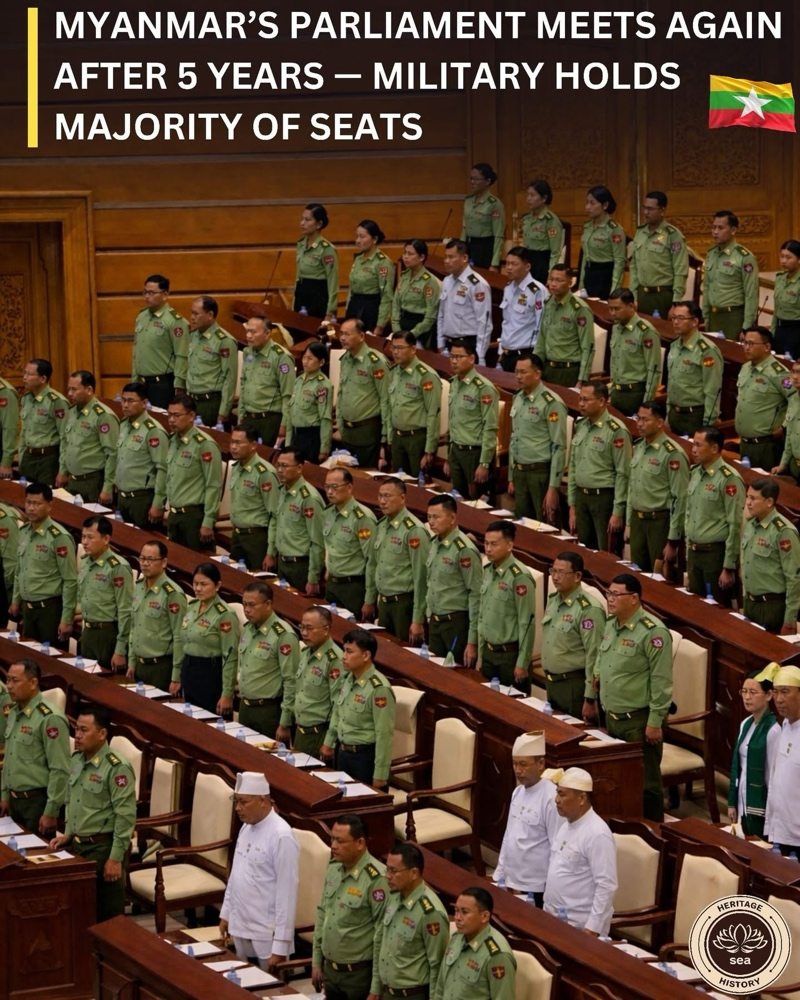
NAYPYITAW — Today, March 16, 2026, the gold-roofed parliamentary complex in Naypyitaw saw the first gathering of lawmakers in over five years. The session of the Pyithu Hluttaw (House of Representatives) marks the culmination of a controversial transition plan by the military junta to trade its olive-drab uniforms for the veneer of civilian governance.
However, the hall was filled almost exclusively with military officers and members of the army-backed Union Solidarity and Development Party (USDP), following a phased election that the international community has largely dismissed as a sham designed to entrench authoritarian rule.
A Legislature Under Tightly Guarded Control
The first order of business on Monday morning was the election of house speakers. Khin Yi, a retired brigadier-general and chairman of the USDP, was elected Lower House Speaker. Security in the capital was reportedly at its highest level in years, with roads leading to the parliament complex sealed and vehicles searched for explosives following a recent earthquake that had damaged the facility last year.
Under the military-drafted 2008 Constitution, 25% of all seats (166 seats) are automatically reserved for serving military personnel. When combined with the USDP’s massive “victory” in the December and January polls, the military bloc now controls approximately 86% of the 586-seat legislature.
The “Phased” Election of 2025–2026
The road to today’s session began with a multi-stage election held between December 28, 2025, and January 25, 2026. According to official figures:
- The USDP won 339 seats, capitalizing on the dissolution of the popular National League for Democracy (NLD) and other major opposition parties that refused to participate under restrictive junta-made laws.
- Participation was limited: Voting took place in only 263 of the country’s 330 townships. One-fifth of the country was excluded entirely due to active fighting between the military and resistance forces.
- Legal Barriers: New laws required parties to have at least 100,000 members and roughly $35,000 in funds, effectively pricing out local and ethnic opposition groups.
A “Military in Civilian Clothing”
While the junta presents this as a return to constitutional rule, UN experts and human rights groups warn of a “legal paradox.” Tom Andrews, the UN Special Rapporteur on Myanmar, noted in his final report to the Human Rights Council that the spectacle fooled no one.
Critics argue the new structure is designed to allow Senior Gen. Min Aung Hlaing to assume the presidency while maintaining control through a newly created “consultative body” that oversees national security and legislation. This allows the military to retain de facto control without formally leading the day-to-day executive branch.
Human Toll and Resistance
Outside the guarded walls of Naypyitaw, the country remains in the grip of a brutal civil war. Since the 2021 coup:
- An estimated 3.4 million people have been internally displaced.
- More than 100,000 homes have been burned.
- Airstrikes on civilian targets increased from just 9 in 2021 to over 1,140 in the past year.
The National Unity Government (NUG), Myanmar’s government-in-exile, continues to maintain that it holds the only legitimate claim to govern based on the 2020 elections, leaving the country with no clear answer as to who actually rules in the eyes of international law.