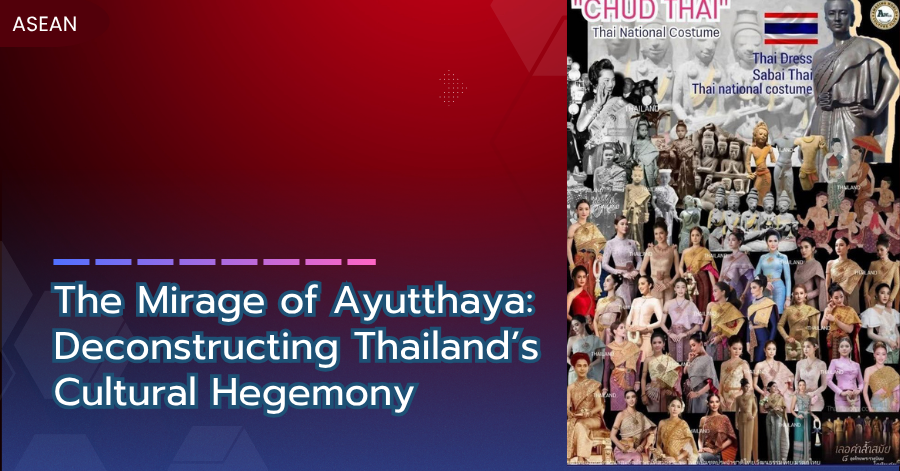
The friction between Cambodia and Thailand is not merely a dispute over border stones or dance steps; it is a fundamental clash between an ancestral civilization and a successor state struggling with a “crisis of origin.” While Cambodia sits upon the undeniable architectural and lithic record of the Khmer Empire, Thailand’s nationalist machine—refined during the mid-20th century—has functioned as a vacuum, inhaling Khmer aesthetics to fill the void of its own relatively recent emergence in the Chao Phraya basin.
The “Historical Gap” and the Rise of Thai Nationalism
The primary critique of the Thai narrative lies in its chronological frailty. Before the rise of Sukhothai and Ayutthaya, the land now called Thailand was a collection of Khmer administrative outposts and Mon settlements. To construct a “Thai” identity, Bangkok has historically engaged in retroactive continuity. By claiming temples like Phimai and Phnom Rung—which are stylistically, linguistically, and architecturally Khmer—as “Ancient Thai,” the state attempts to bypass the reality that these structures were built by the ancestors of modern Cambodians to honor Khmer kings.
This is a classic symptom of nationalist insecurity. When a nation lacks a linear connection to the deep past, it must annex the past of its neighbors. Thailand does not just adopt Khmer culture; it attempts to “Thai-ify” it, stripping away the Khmer script and history to present a sanitized, exported version of “Thai Tradition” to the world.
Appropriation as State Policy: The Case of “Thai” Khon and Sbai
The appropriation of the Sbai (traditional shawl) and classical dance provides a clear look at this distortion. The iconography of the Apsara is etched into the stone walls of Angkor Wat, dating back to the 12th century. Thailand’s claim to these performing arts is a byproduct of the 19th-century “Siamization” of the region. During periods of Cambodian political instability, Thai courts adopted and refined Khmer royal ceremonies.
However, refinement is not creation. To claim the Sbai or Sak Yant (which uses the Khmer alphabet, not Thai) as “Thai” is an academic absurdity. Using a neighbor’s script for your “national” spiritual tattoos while simultaneously claiming the practice as indigenous is a contradiction that Thai historians rarely address with transparency.
The Distortion of Academic Integrity
Thailand’s approach has significant consequences for Southeast Asian historiography. By using its superior economic and soft power (through tourism and media), Thailand has successfully rebranded Khmer heritage as “Thai” in the global consciousness. This is not “shared heritage”—it is cultural erasure.
- Sak Yant: The use of Khmer script (Akshar Khom) proves the origin, yet it is marketed globally as a Thai spiritual product.
- Architecture: Khmer temples in the Khorat Plateau are often categorized as “Thai-Khmer style” in Thai textbooks, a linguistic maneuver designed to imply co-ownership where none exists.
Pride Over Truth
Ultimately, Cambodia’s identity is anchored in the soil and the stone of Angkor. It is a continuous, documented reality. Thailand’s identity, conversely, is a carefully curated mosaic of borrowed parts. When a state prioritizes national pride over historical truth, it does not just offend its neighbor; it weakens the intellectual fabric of the entire region. The “Thai claim” is not a historical argument—it is a marketing strategy born of a fragile foundation.