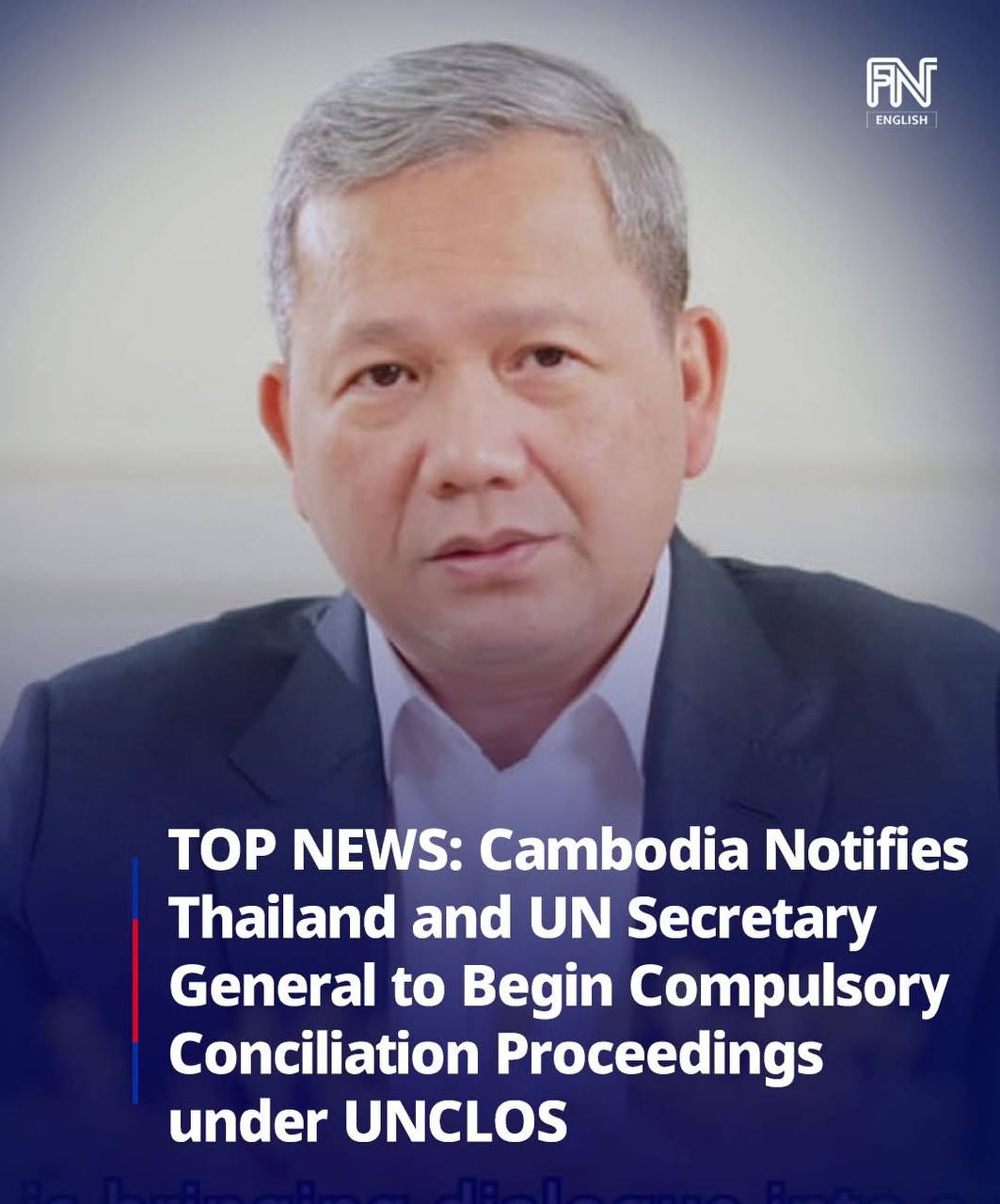
In a major diplomatic and legal escalation in Southeast Asia, Cambodian Prime Minister Hun Manet announced in a special address on state-run television (TVK) that Cambodia has officially initiated compulsory conciliation proceedings against Thailand under the United Nations Convention on the Law of the Sea (UNCLOS).
Phnom Penh has delivered a formal notice to the Thai government and submitted an official notification to the United Nations Secretary-General to trigger the international mediation mechanism.
The decisive legal maneuver comes in direct response to the Thai Cabinet’s unilateral termination of the 2001 Memorandum of Understanding (MOU 44) regarding overlapping maritime claims in the Gulf of Thailand. Thai Prime Minister Anutin Charnvirakul’s administration had scrapped the 25-year-old bilateral framework, citing a lack of structural progress—a move that followed intense nationalist campaigning and deadly military border skirmishes between the two neighbors along their land frontier.
Understanding the Legal Shift: From MOU 44 to UNCLOS Annex V
For more than two decades, the two nations attempted to manage their Overlapping Claims Area (OCA)—a 26,000-square-kilometer maritime zone rich in oil and natural gas reserves valued at an estimated $300 billion—via bilateral negotiations under MOU 44. However, Thailand’s sudden exit from the pact left Cambodia with no alternative but to internationalize the dispute.
Because both countries previously opted out of the binding dispute settlement mechanisms under Part XV of UNCLOS for sea boundary delimitations, Cambodia invoked Article 298 and Annex V (Section 2) of the convention. This specific clause dictates that if bilateral talks fail to yield an agreement within a reasonable timeframe, one state can oblige the other to submit to a structured, independent conciliation commission.
+-------------------------------------------------------------------------+
|                      OCA MARITIME DISPUTE TIMELINE                      |
|                                                                         |
| [2001: MOU 44 Signed] ---> [2025: Land Border Clashes]                  |
|                                     |                                   |
|                                     v                                   |
| [June 2, 2026: UNCLOS Invoked] <--- [May 5, 2026: Thailand Scraps MOU]   |
+-------------------------------------------------------------------------+
“Not Escalation, But Structured Dialogue”
Prime Minister Hun Manet strongly defended the action, clarifying that internationalizing the dispute is an act of peace and legal sovereignty rather than an aggressive escalation.
“We have taken this step to protect Cambodia’s sovereignty and maritime rights in accordance with international law,” Prime Minister Hun Manet stated. “Let me be clear, initiating the compulsory conciliation under the UNCLOS does not mean that Cambodia is turning away from dialogue. Cambodia is bringing dialogue into a structured international framework recognized by both countries.”
Cambodia has already assembled a formidable legal team to lead the proceedings, appointing Foreign Minister Prak Sokhonn as its principal representative. To spearhead the case, Cambodia has retained world-renowned international law experts, including Danish diplomat Peter Taksøe-Jensen and French academic Jean-Marc Thouvenin.
What Happens Next? The 21-Day Clock for Bangkok
The initiation of the UN-backed procedure places immediate diplomatic pressure on Bangkok. Under the strict rules of UNCLOS Annex V:
- The 21-Day Deadline: Thailand now has exactly 21 days to respond and appoint two conciliators of its own choice to the panel.
- Panel Formation: Once Thailand selects its representatives, the appointed conciliators from both nations will jointly choose an independent fifth member to serve as the chairperson of the Conciliation Commission.
- The Outcome: The independent commission will review the technical and historical maritime claims of both nations and issue formal recommendations.
While the final recommendations issued under a compulsory conciliation process are not legally binding, the framework is highly effective at forcing stalemated nations toward a compromise. Prime Minister Hun Manet cited the historic success of the 2018 Timor-Leste and Australia maritime boundary resolution, which successfully utilized the exact same UNCLOS mechanism to untangle a bitter, multi-billion-dollar resource dispute.
Thailand’s Reaction
Speaking from Government House in Bangkok following a cabinet meeting, Thai Prime Minister Anutin Charnvirakul maintained a dismissive public stance, stating that Thailand had no immediate need to “counter” Phnom Penh’s legal filing. While Thailand has traditionally fiercely resisted bringing bilateral friction into international forums, preferring to leverage its economic and military weight in closed-door sessions, it cannot easily ignore the UNCLOS process without damaging its standing as a rules-based actor in ASEAN.
With global energy markets highly volatile, both nations face intense economic pressure to unlock the massive oil and gas reserves trapped beneath the Gulf of Thailand. Whether this UN-backed intervention will smoothly pave the way for a joint development treaty or deepen the geopolitical rift between Phnom Penh and Bangkok will depend entirely on how the incoming conciliation panel navigates the rigid laws of the sea over the coming months.
Direct Sources & Further Reading
- For details on the official announcements from Phnom Penh, read the coverage on the Khmer Times and The Cambodia Daily.
- For regional analysis regarding the $300 billion energy stakes, consult The Hindu and Nation Thailand.
- For an breakdown of the official Thai government response to the filing, review The Star/AseanPlus.
- For an expert legal analysis on the invocation of Article 298 and Annex V, see the briefing by public international law firm Volterra Fietta.