

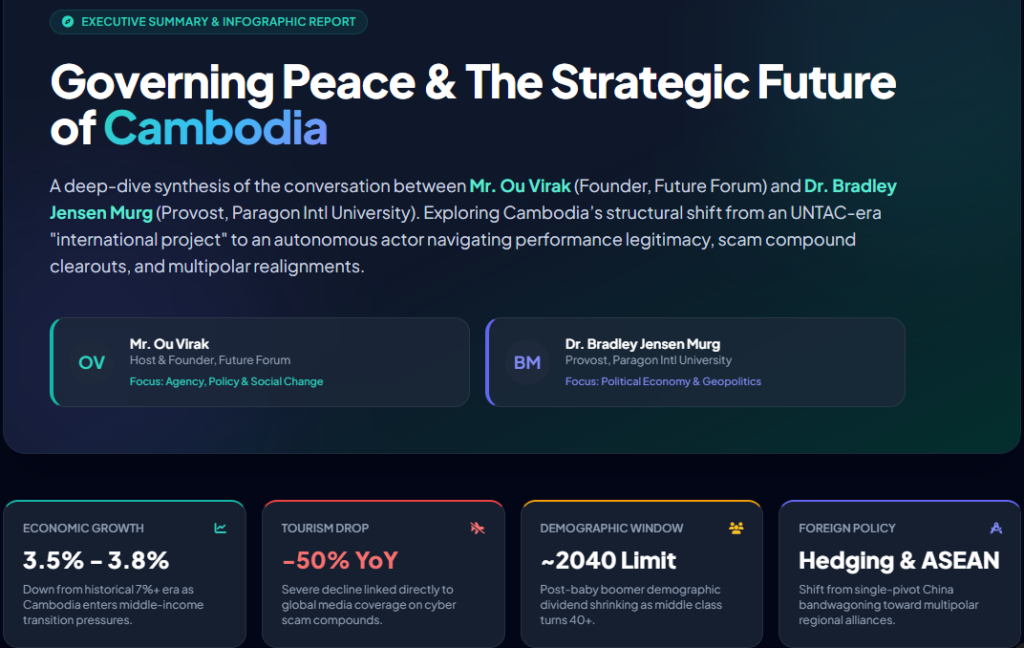
When looking back at the trajectory of contemporary Southeast Asia, few nations present as stark a study in rapid transformation and strategic recalibration as Cambodia. Once viewed almost exclusively through the tragedy of its late 20th-century history, the Kingdom has spent the last three decades attempting to outrun its past. In a candid, wide-ranging discussion on the Horizon podcast, hosted by Mr. Ou Virak, founder of the Phnom Penh-based think tank Future Forum, and featuring Dr. Bradley Jensen Murg, Provost and Vice Rector for Academic Affairs at Paragon International University, the two veteran analysts unpack the complex political, economic, and foreign policy crossroads facing Cambodia today. The conversation provides an insider’s look into a nation attempting to move beyond its identity as a post-conflict “international project” into a self-determined actor navigating an increasingly unstable multipolar world.
To understand Cambodia’s current moment, one must first dismantle the long-standing international consensus that took root following the United Nations TAC (UNTAC) period in the early 1990s. For decades, Western powers, international non-governmental organizations, and multilateral agencies treated the country as a well-meaning ward—a global poster child for post-conflict state-building. As Ou Virak reflects, this benevolent patron state dynamic eventually became a self-perpetuating constraint. He recalls feeling a deep frustration with how international observers and domestic politicians alike continually litigated Cold War-era grievances, noting that this dynamic passed a contagious sense of powerlessness down to younger generations. In his view, treating the country as an endless development project stripped young Cambodians of their innate agency, signaling to them that external forces would always dictate their destiny.
It was precisely to challenge this narrative that Future Forum and Dr. Murg collaborated on the Cambodia 2040 initiative, a multi-volume strategic foresight project designed to compel young scholars and policymakers to actively visualize and build their own future. Reflecting on the project, Dr. Murg notes that applying strategic foresighting methodology to soft domains like culture, identity, and governance was an ambitious undertaking, but one that yielded remarkably accurate predictions regarding the country’s trajectory. The underlying thesis was simple yet radical for its time: structural legacies do not fully dictate the future, and Cambodians themselves must possess the agency to make hard choices today if they wish to realize their ideal scenarios for tomorrow. Both thinkers agree that while international goodwill brought essential resources in the post-war era, the nation has reached a definitive tipping point where it must take full ownership of its domestic institutions and international standing.
This quest for agency is unfolding against the backdrop of a profound demographic shift that is reshaping the country’s social fabric. Cambodia is no longer the nation of the early 2000s, where an overwhelming majority of the population was under thirty and rural-to-urban migration was just beginning to gather pace. Today, the post-conflict generation has matured into a rising class of urban professionals, technocrats, and young parents who possess vastly different priorities, expectations, and civic tools than their predecessors. Dr. Murg highlights how this evolving middle class is redrawing social class markers and mobility. He points out that the emergence of an educated, asset-owning professional class means citizens now have tangible property, businesses, and children’s futures to protect. Consequently, their engagement with the state has become far more pragmatic and demanding.
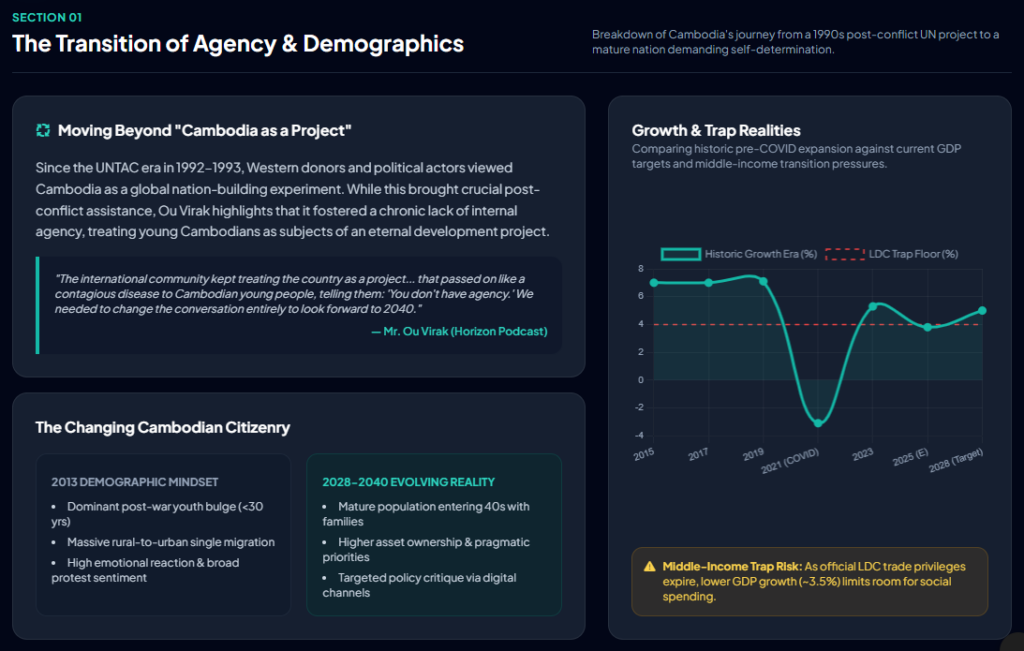
This new social dynamic is already asserting itself in daily civic life. Both speakers observe that modern Cambodian parents and professionals are no longer passive recipients of policy decisions. When government ministries issue ill-advised directives, social media channels are instantly inundated with structured, well-informed critiques from middle-class citizens, frequently forcing quick policy reversals. Furthermore, the nature of labor and spatial mobility is shifting. While millions of Cambodian workers previously migrated to Thailand for unskilled labor, recent border closures and regional economic friction have forced a massive repatriation of workers. Coupled with internal inter-provincial migration and a growing brain drain of highly educated youth moving to Western nations, the Kingdom faces a critical mismatch between available domestic jobs and the evolving skill sets of its population.
Perhaps the most pivotal structural evolution discussed in the podcast is the long-anticipated generational transition within Cambodia’s political leadership. The handover of executive power to a younger generation of Western-educated technocrats, led by Prime Minister Hun Manet, represents the first systemic political transition since the restoration of national sovereignty. Dr. Murg acknowledges that the sheer speed and familial nature of the cabinet turnover drew intense domestic and international criticism. He notes that because executive posts were passed directly from fathers to sons across multiple elite families, the transition appeared to many observers as strikingly nepotistic. However, he places this within a broader regional context, observing that family oligarchies and hereditary political dynasties have long been normalized across Southeast Asia, from the Philippines to Thailand.
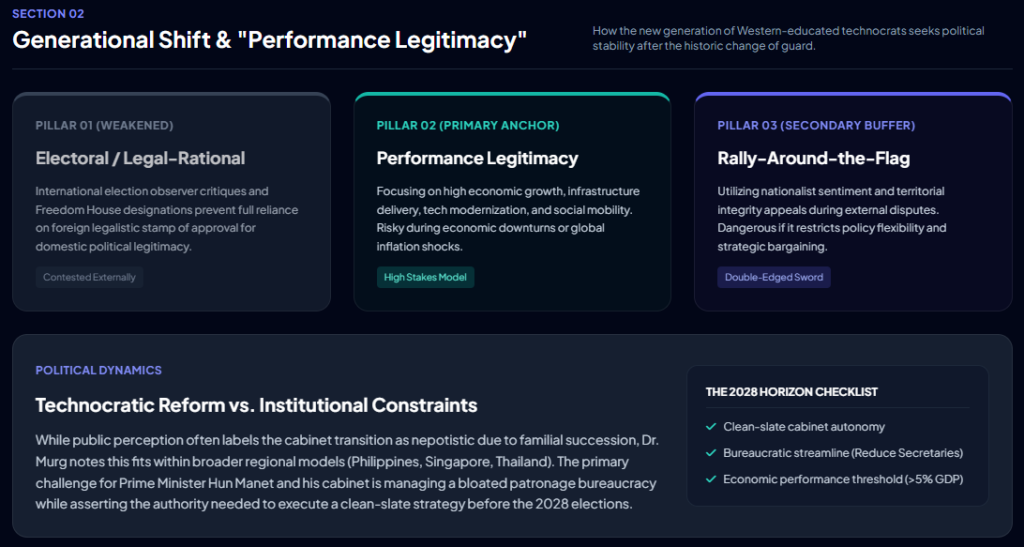
The core challenge facing this new political guard is not simply managing public relations, but establishing genuine political legitimacy. Drawing on Max Weber’s classic frameworks of authority, Dr. Murg and Ou Virak argue that traditional legal-rational legitimacy, derived purely through flawless electoral processes, remains fraught due to persistent international skepticism and domestic critiques regarding political space. Deprived of a seamless legalistic stamp of approval from foreign critics, the new government has leaned heavily into what political scientists term performance legitimacy—a governance model similar to those employed in neighboring single-party states. Under this implicit social contract, the state promises economic stability, infrastructure expansion, and rising living standards in exchange for social order and public compliance.
However, relying strictly on performance legitimacy is an inherently risky strategy, particularly during periods of global economic turbulence. As Ou Virak emphasizes, performance is judged not by vague political promises, but by concrete economic outcomes and everyday realities. If GDP growth stutters, living costs rise, and household debt becomes unmanageable, the single pillar supporting public acquiescence begins to crumble. To offset this vulnerability, governments frequently resort to nationalism as a secondary pillar to rally popular support. Yet, both speakers caution that playing the nationalist card is a double-edged sword. While appeals to national pride can unify a public during short-term crises, they severely restrict a government’s diplomatic flexibility, locking leadership into rigid postures from which they cannot easily retreat without facing severe domestic backlash.
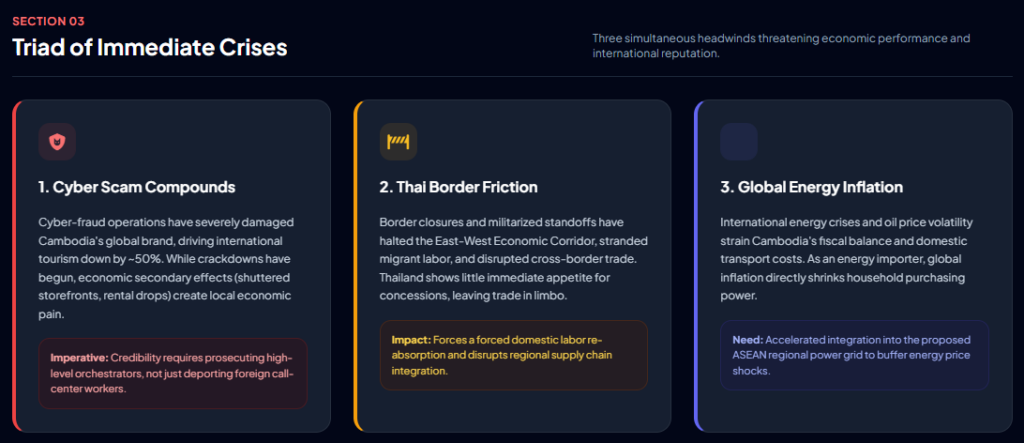
This delicate balance between performance and stability is currently being tested by a triad of converging internal and external crises. Chief among these domestic headaches is the urgent necessity of eradicating the systemic online “scam compounds” that have metastasized across the country over the past several years. Dr. Murg and Ou Virak do not mince words regarding the catastrophic impact these criminal networks have had on the nation’s international standing. Dr. Murg notes with grave concern that the country’s brand has been so severely tarnished by global news coverage of human trafficking and cyber-fraud that rebuilding reputation among foreign investors and international tourists is akin to working on a blank, damaged canvas. The precipitous drop in international tourism numbers—falling dramatically even compared to previous disappointing years—is a direct symptom of heightened global safety concerns.
Addressing the scam compound phenomenon presents a complex economic paradox for the new administration. During the pandemic years, the illicit activities and associated gray-market money flows provided an undeniable, albeit toxic, liquidity cushion for local businesses, real estate, and service industries. As law enforcement operations gradually tighten and compound operators flee, entire urban districts are experiencing a secondary economic shock. Drive through parts of Phnom Penh or coastal hubs, and one sees rows of shuttered storefronts and pervasive “for rent” signs reminiscent of the pandemic lockdown era. Yet, both commentators firmly agree that a half-hearted cleanup will not suffice. Ou Virak argues that for Cambodia to regain international credibility, the government must demonstrate the political courage to go after high-level orchestrators and politically connected figures rather than merely deporting low-level foreign call-center workers.
Compounding these domestic enforcement challenges are severe external economic headwinds. The ongoing border friction with Thailand has crippled cross-border trade, disrupted regional supply chains, and abruptly ended the livelihoods of hundreds of thousands of border-region families who relied on organic local commerce. Simultaneously, volatile global energy markets triggered by international conflicts have pushed fuel prices upward, stoking inflation and dampening economic growth forecasts. Where Cambodia once comfortably enjoyed annual GDP growth rates exceeding seven percent, current projections have slowed significantly toward the three-to-five percent range. For a developing country with a rapidly growing population, such reduced growth rates signal an early onset of the middle-income trap, leaving little room for fiscal error.
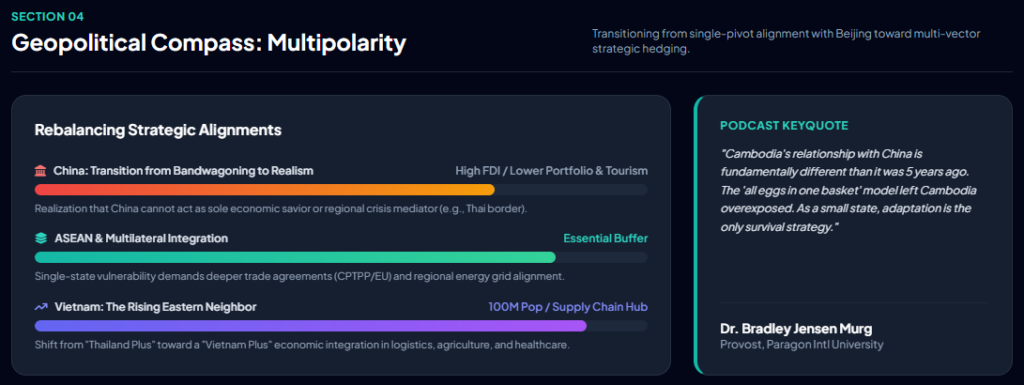
These domestic economic pressures directly intersect with Cambodia’s broader foreign policy positioning in an increasingly volatile multipolar world. Historically, the post-COVID era represented the apex of Phnom Penh’s diplomatic and economic alignment with Beijing. Huge influxes of Chinese capital, infrastructure loans, and real estate investments led many Western analysts to view Cambodia as a firm Chinese client state. However, Dr. Murg and Ou Virak argue that the limitations of this “all eggs in one basket” approach have become painfully obvious. When Chinese tourism collapsed and portfolio investment slowed, Cambodia was left economically exposed and diplomatically isolated. The host and guest agree that the era of simple binary choices—bandwagoning wholeheartedly with one superpower over another—is officially over.
Today, Cambodian policymakers are actively pursuing a strategy of strategic hedging and diplomatic diversification. The realization has set in that China, while remaining a vital trade partner and source of foreign direct investment, cannot serve as a sole security guarantor or economic savior, particularly as Beijing navigates its own internal demographic and economic realignments. Consequently, Phnom Penh is making concerted efforts to repair ties with Western nations, deepen trade integration with Europe, and actively participate in broader multilateral frameworks. Furthermore, both speakers stress that Cambodia must look closer to home and reinvest its diplomatic capital in ASEAN. While acknowledgeing the regional bloc’s institutional flaws and slow consensus building, Dr. Murg emphasizes that for a small state, multilateral integration within ASEAN remains the single best defense against bilateral coercion by larger powers.
A crucial, yet frequently overlooked, variable in Cambodia’s regional calculus is the shifting posture of its eastern neighbor, Vietnam. While public and diplomatic attention has been heavily consumed by tensions along the Thai border, Vietnam has quietly transformed into an economic powerhouse and an increasingly assertive regional actor. With a highly educated population of one hundred million and deep integration into global technology supply chains, Hanoi is no longer merely adapting to regional dynamics—it is actively shaping them. Dr. Murg points out that Cambodian supply chains, agricultural imports, and cross-border medical travel are becoming inextricably bound to Vietnam. As the dust eventually settles on other regional disputes, managing this multi-faceted, historically complex relationship with a confident and economically dominant Vietnam will require immense diplomatic sophistication from Phnom Penh’s young leadership.
As the discussion draws to a close, Dr. Murg and Ou Virak land on a message of cautious, pragmatic realism. The initial “honeymoon period” enjoyed by the new administration has definitively ended, and the government now faces the cold reality of managing complex structural reforms under tight economic constraints. Yet, despite the formidable challenges—from cleaning up illicit gray economies to navigating great-power rivalries—there remains a underlying sense of optimism rooted in the country’s human capital. The rising generation of Cambodian professionals, technocrats, and civic leaders possesses the education, global awareness, and determination necessary to chart a more stable course. In an unpredictable global environment, small-state survival ultimately depends on adaptability, institutional integrity, and the willingness to make difficult choices. For Cambodia, the task ahead is no longer about proving its ability to recover from past tragedy, but demonstrating its capacity to perform, govern, and thrive on the modern global stage.
Leave a Reply