
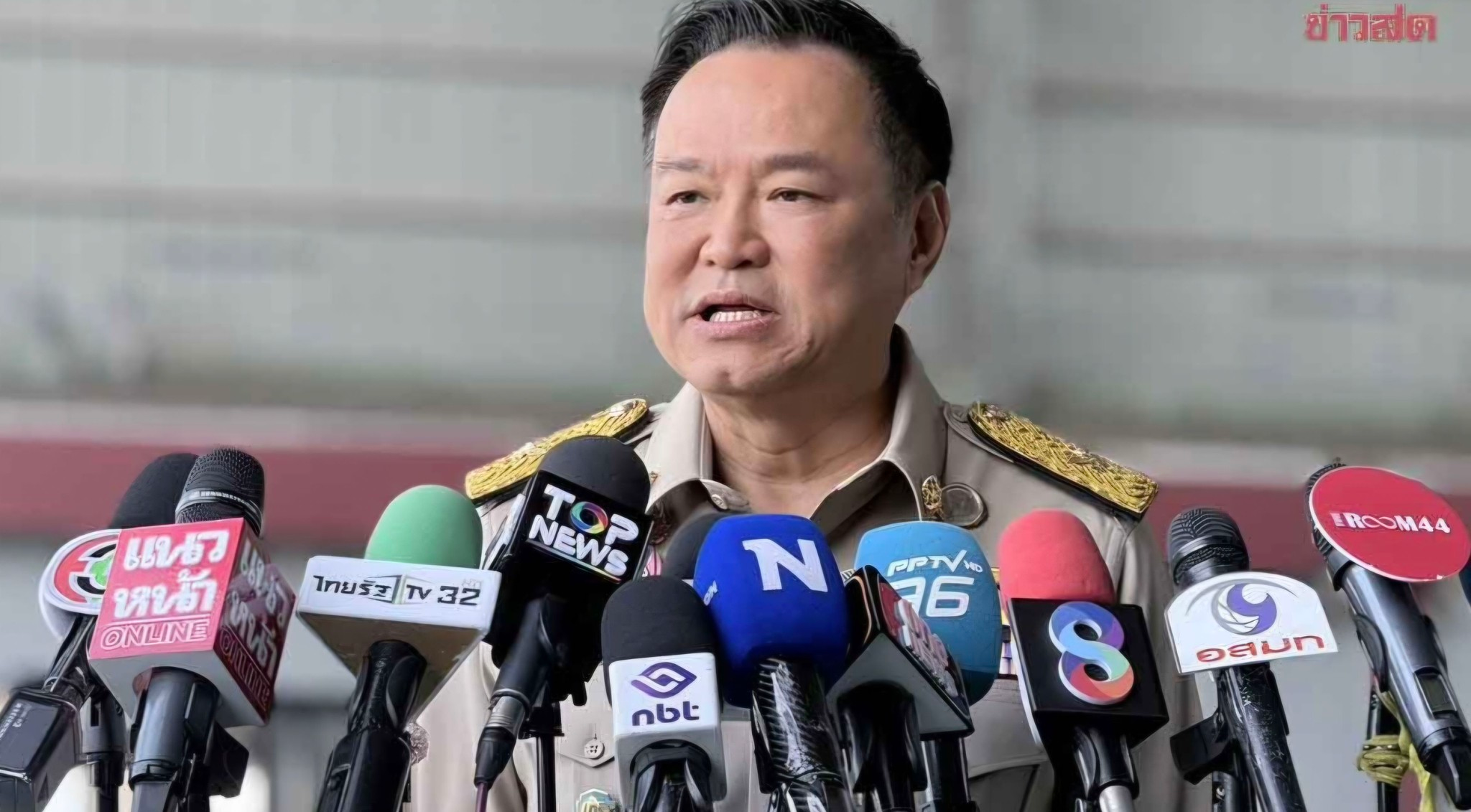
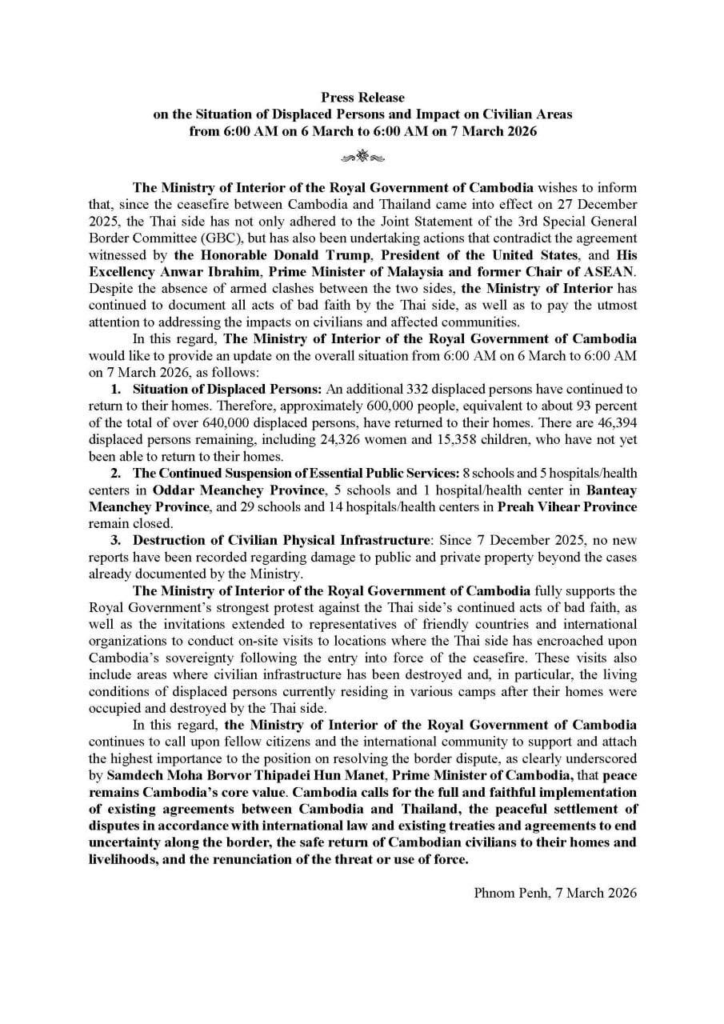
PHNOM PENH, March 8, 2026 — As Thailand’s newly elected government under Prime Minister Anutin Charnvirakul reinforces its nationalist border policies, the Ministry of Interior of the Royal Government of Cambodia has issued a formal press release detailing the ongoing humanitarian crisis and diplomatic “bad faith” following the December 2025 ceasefire.
Despite the absence of active kinetic combat, the Cambodian government alleges that the Thai side is failing to adhere to the Joint Statement of the 3rd Special General Border Committee (GBC). This agreement, notably witnessed by U.S. President Donald Trump and Malaysian Prime Minister Anwar Ibrahim, was intended to stabilize the region after the 2025 border crisis. Cambodia maintains that Thailand has undertaken actions that directly contradict this agreement, leading to a formal protest against perceived encroachments on Cambodian sovereignty.
Humanitarian Snapshot: The Displacement Crisis
While the region moves slowly toward normalization, the human cost remains high:
- Mass Return: Approximately 600,000 people (93% of the displaced population) have successfully returned to their homes.
- Remaining Displaced: There are still 46,394 individuals unable to return, including 24,326 women and 15,358 children.
- Essential Service Gaps: Public infrastructure remains paralyzed in border provinces. Currently, 42 schools and 20 hospitals/health centers across Oddar Meanchey, Banteay Meanchey, and Preah Vihear remain closed.
Infrastructure and International Oversight
The Ministry confirmed that while no new destruction of civilian infrastructure has been recorded since December 7, 2025, previous damage remains a point of contention. In a move to bolster its diplomatic position, Cambodia has invited international representatives and “friendly countries” to conduct on-site visits to inspect areas where homes were occupied or destroyed by Thai forces.
The statement reinforces the “serene vigilance” mentioned by Prime Minister Hun Manet, emphasizing that while peace is Cambodia’s core value, it must be met with a “full and faithful implementation” of existing treaties.
This diplomatic stance directly clashes with the recent electoral mandate in Thailand, where Prime Minister Anutin’s “No Retreat” policy and vows to scrap previous MOUs have created a policy deadlock. As Cambodia calls for a peaceful settlement in accordance with international law, the rhetoric from Bangkok regarding border walls and maritime claim terminations suggests that the road to total de-escalation remains fraught with nationalist hurdles.
Leave a Reply