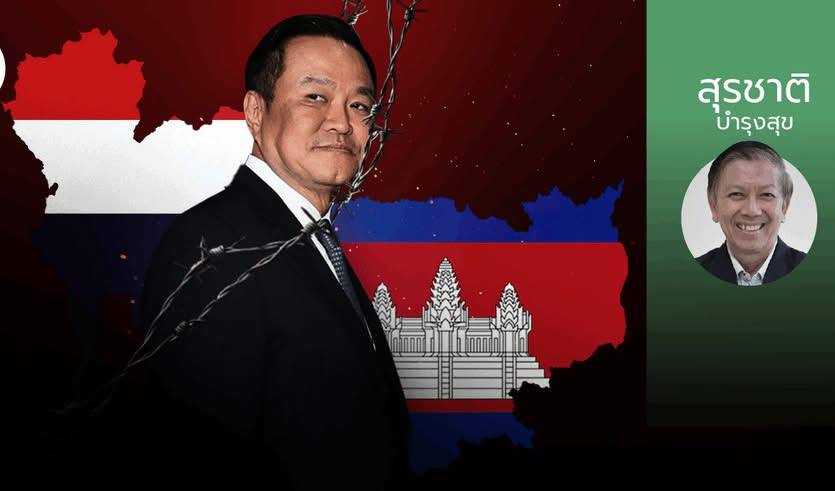
The persistent maritime and terrestrial border disputes between Thailand and Cambodia have re-entered a critical diplomatic phase. A public warning from Dr. Surachart Bamrungsuk, a renowned geopolitical expert and professor of political science at Chulalongkorn University, has exposed a deep structural flaw in Bangkok’s approach to international law. In an open letter addressed to Thai Prime Minister Anutin Charnvirakul, Dr. Surachart warned that the administration’s aggressive insistence on utilizing Thailand’s internal 1:50,000 military maps—while rejecting historical Franco-Siamese treaties and the 1:200,000 scale Annex I map—is a dangerous geopolitical blunder. He flatly stated that pursuing this path would inevitably lead Thailand to a third humiliating defeat at the International Court of Justice (ICJ), because international tribunals do not recognize self-drafted, unilateral maps.
Dr. Surachart’s critique is not merely an academic dissent; it is rooted in established international jurisprudence, historical treaty frameworks, and the doctrines of international law. By deconstructing the prime minister’s rhetoric, analyzing the legal precedents of 1962 and 2013, and examining the technical limitations of unilateral military mapping, we can see why Bangkok’s current legal posture is untenable under modern international law.
1. The Legal Primacy of Franco-Siamese Treaties vs. Unilateral Maps
The core of Prime Minister Anutin Charnvirakul’s border strategy relies on a strict ultimatum: Thailand will only negotiate using its domestic 1:50,000 scale military maps and will reject any discussions anchored in the 1:200,000 scale maps historically invoked by Cambodia. However, under settled international law, a state cannot unilaterally alter treaty-defined boundaries or introduce domestic cartography to supersede bilaterally ratified agreements.
The border between Cambodia and Thailand is legally governed by three foundational instruments concluded between the Kingdom of Siam and the French Republic (acting on behalf of Cambodia):
- The Treaty of 1893
- The Convention of February 13, 1904
- The Treaty of March 23, 1907
The 1904 Convention established a Mixed Commission of French and Siamese officials tasked with delimiting the frontier. A subset of this commission, tasked with mapping the Dângrêk mountain range, produced a series of 11 maps in 1907–1908, printed in Paris. Among these was the famous “Annex I” map, drawn to a scale of 1:200,000, which placed the historic Preah Vihear Temple within Cambodian territory.
+-----------------------------------------------------------------------+
|                       FOUNDATIONAL TREATY FLOW                        |
|                                                                       |
|   [1893 Treaty] ---> [1904 Convention] ---> [1907 Treaty & Mapping]   |
|                             |                         |               |
|                             v                         v               |
|                     Mixed Commission           11 Maps Produced       |
|                     Delimitation Work          (Inc. Annex I 1:200k)  |
+-----------------------------------------------------------------------+
Under the international law of treaties, codifying the principle of pacta sunt servanda (agreements must be kept) as formalised in the Vienna Convention on the Law of Treaties (VCLT), states are legally bound by the instruments they ratify. Article 26 of the VCLT dictates that treaties are binding upon the parties and must be performed in good faith, while Article 27 explicitly bars a state from invoking its internal law—or internal technical documents—as justification for failing to perform a treaty.
By asserting that Thailand will only recognize its internal 1:50,000 maps, the Thai administration attempts to elevate a domestic military tool above binding international conventions. In international boundary arbitrations, a map possesses no independent legal value unless it is an integral part of a treaty or has been accepted by the parties as a valid representation of the boundary line. Unilateral maps drawn by one party to maximize its territorial gains hold zero weight in international courts when confronted with bilaterally generated historical documents.
2. The 1962 Preah Vihear Precedent and Estoppel
The Thai government’s current rhetoric mirrors the failed legal defense mounted by Field Marshal Sarit Thanarat’s administration in the late 1950s and early 1960s. When Cambodia took Thailand to the International Court of Justice in 1959 over the occupation of Preah Vihear, the Thai legal team argued that the 1:200,000 Annex I map was invalid because it deviated from the natural watershed line stipulated in the text of the 1904 Convention. Thailand presented its own internally generated maps to support its claim.
The ICJ comprehensively rejected Thailand’s arguments in its landmark 1962 Judgment concerning the Temple of Preah Vihear. The Court ruled that even if the Annex I map contained cartographical errors or departed from the watershed line, the Siamese authorities had received the maps in 1908, held them without protest for decades, and enjoyed the benefits of the treaties. The court applied the legal doctrine of preclusion or estoppel, stating:
“It is an established rule of law that a plea of error cannot be allowed as an element vitiating consent if the party advancing it contributed by its own conduct to the error… Siam received the Annex I maps and kept them; she made no protest for many years, and must therefore be held to have acquiesced.”
Furthermore, during a 1930 visit to the temple by Siamese Prince Damrong, the French authorities openly received him as a foreign dignitary under the French flag. The Prince’s failure to object further cemented Thailand’s legal acquiescence.
By threatening to walk away from negotiations unless Cambodia surrenders the 1:200,000 framework, Prime Minister Anutin is ignoring the principle of res judicata (a matter already judged). The ICJ has already ruled that the Annex I map is legally binding on both nations because of historical acceptance. Re-litigating the validity of the 1:200,000 scale map is a dead end under international law.
3. The Technical Deception of the 1:50,000 Military Map
The Thai leadership continuously touts its 1:50,000 military map as a superior, modern, and legally bulletproof instrument. In reality, this map has no standing in international dispute resolution.
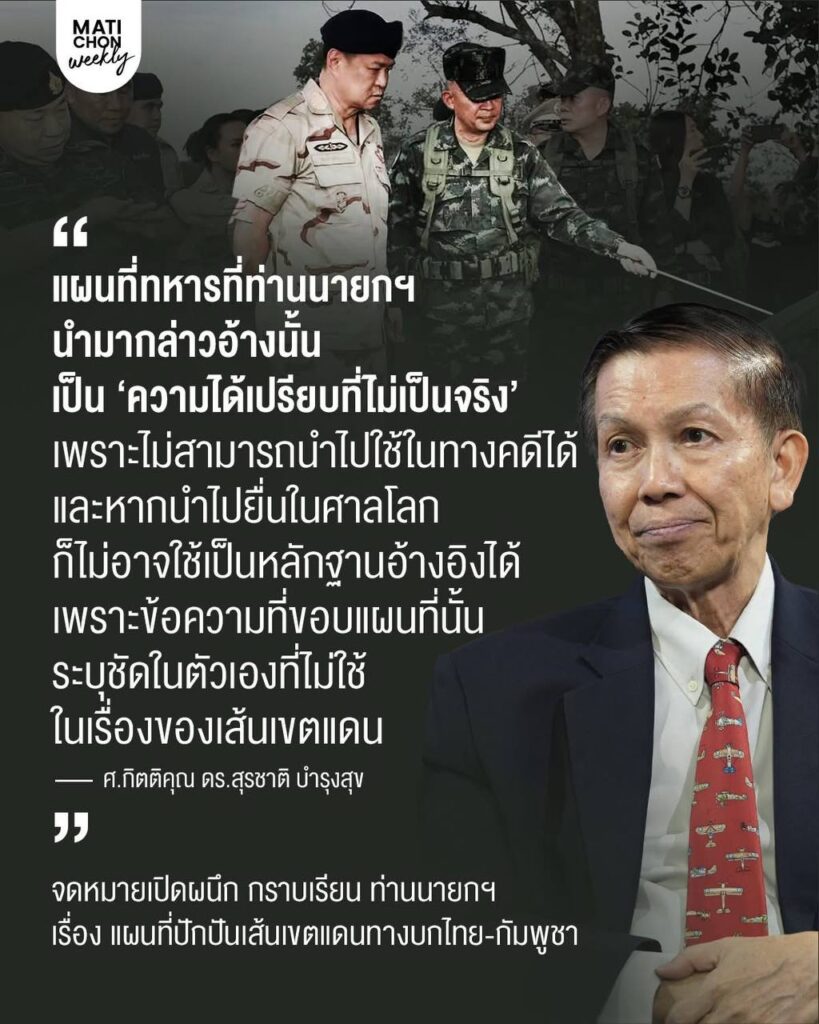
As Dr. Surachart pointed out, these maps were created by the Royal Thai Army’s Survey Department for internal tactical operations, national defense logistics, and domestic sovereignty management. They are completely unilateral instruments. Crucially, like nearly all domestic military mapping produced globally, these sheets contain explicit technical disclaimers in their margins, typically reading:
“Boundary representation is not necessarily authoritative.”
This standard disclaimer is a legal safety valve. It indicates that the cartographers who drew the map acknowledge that the lines depicted do not constitute a legally binding international boundary, but are rather an approximation for internal operational use.
If Thailand attempts to bring these 1:50,000 maps before an international body like the Permanent Court of Arbitration (PCA) or the ICJ, the opposing counsel would immediately weaponize the map’s own disclaimer to nullify its evidential value. Under the international rules of evidence applied by the ICJ, maps are treated merely as admissions or secondary evidence, unless annexed directly to a treaty. A self-serving map created by a state’s own military branch cannot overwrite an international boundary agreed upon with a foreign sovereign.
4. The Dangerous Strategy of Denying Historical Frameworks
Some political factions in Bangkok advocate for a “clean slate” approach—essentially nullifying the 1893, 1904, and 1907 treaties on the grounds that they were “unequal treaties” forced upon Siam by French colonial expansion. This nationalist narrative paints early Thai negotiators as helpless victims of colonial bullying.
However, historical records tell a different story. The Siamese commissioners and surveyors of the early 20th century were highly educated, technically proficient, and actively participated in the boundary demarcation. They were fully aware of the stakes and successfully protected key territories throughout the negotiation processes.
More importantly, attempting to invalidate these historical treaties is an incredibly dangerous game for Thailand’s own territorial integrity. The entire eastern border of Thailand—spanning both the Thai-Cambodian and the Thai-Laotian frontiers—is legally anchored by these exact same Franco-Siamese treaties. If Thailand declares that the 1904 or 1907 treaty frameworks are null and void because of colonial overreach, it undermines the very legal instruments that secure its sovereignty over thousands of kilometers of its eastern provinces.
Under the customary international law principle of uti possidetis juris (as you possess under law), newly independent states inherit the administrative boundaries established by former colonial powers. This principle has been reinforced globally to prevent chaotic, post-colonial border wars. Cambodia inherited the borders established by French Indochina, and those borders were legally confirmed by Thailand through decades of treaty compliance. Attempting to rip up these foundational texts would plunge Thailand into deep diplomatic isolation and invite endless counter-claims from its neighbors.
5. The Threat of a Third Legal Defeat: 2011, 2013, and Beyond
Thailand’s modern history demonstrates the perils of ignoring international jurisprudence in favor of domestic political posturing. Following nationalist rhetoric and military skirmishes around Preah Vihear between 2008 and 2011, Cambodia bypassed bilateral deadlocks by requesting an interpretation of the 1962 judgment from the ICJ under Article 60 of the Court’s Statute.
Despite initial Thai claims that the ICJ had no jurisdiction or that Thailand could simply ignore the proceedings, Bangkok ultimately felt compelled to assemble an international legal team and defend its position. In its 2013 Judgment on the Request for Interpretation, the ICJ ruled unanimously that the 1962 judgment did indeed determine that the entire promontory of Preah Vihear belonged to Cambodia, and ordered Thailand to withdraw its military forces from that specific area.
| Year | Case / Dispute | Court | Key Finding / Outcome |
| 1962 | Temple of Preah Vihear (Cambodia v. Thailand) | ICJ | Preah Vihear Temple belongs to Cambodia; Annex I map recognized due to Thai acquiescence. |
| 2013 | Request for Interpretation of the 1962 Judgment | ICJ | Unanimously clarified that the entire promontory of Preah Vihear belongs to Cambodia; ordered Thai troop withdrawal. |
The current political posturing by Prime Minister Anutin risks repeating this exact cycle. By loudly proclaiming that Thailand will not recognize the 1:200,000 scale map and demanding that negotiations occur solely under Thai terms, the administration is handing Cambodia a golden opportunity. Cambodia can document these statements as clear evidence of a formal legal dispute over treaty interpretation and once again petition the ICJ or another international tribunal.
Even if Thailand threatens to boycott international arbitration, the court can proceed in absentia under Article 53 of the ICJ Statute, and a binding judgment would still be issued. A third legal defeat would permanently shatter Thailand’s standing as a rules-based actor in ASEAN and international diplomacy.
Trusting Professional Diplomacy Over Domestic Populism
Dr. Surachart Bamrungsuk’s warning is a call for realism and strategic sanity. Border disputes cannot be resolved by playing to domestic nationalist audiences or relying on unilateral military maps that carry zero legal weight abroad.
For Thailand to safeguard its national interests, the current administration must stop treating international law as an existential threat and start utilizing it as it was intended: a structured shield. Bangkok needs to sideline populist political rhetoric and instead consult with professional, career diplomats within the Ministry of Foreign Affairs and veteran surveyors within the Royal Thai Armed Forces Survey Department. True diplomatic strength does not come from trying to bully a neighbor into silence behind closed doors; it comes from standing on a legally sound foundation that can withstand independent scrutiny on the global stage.