
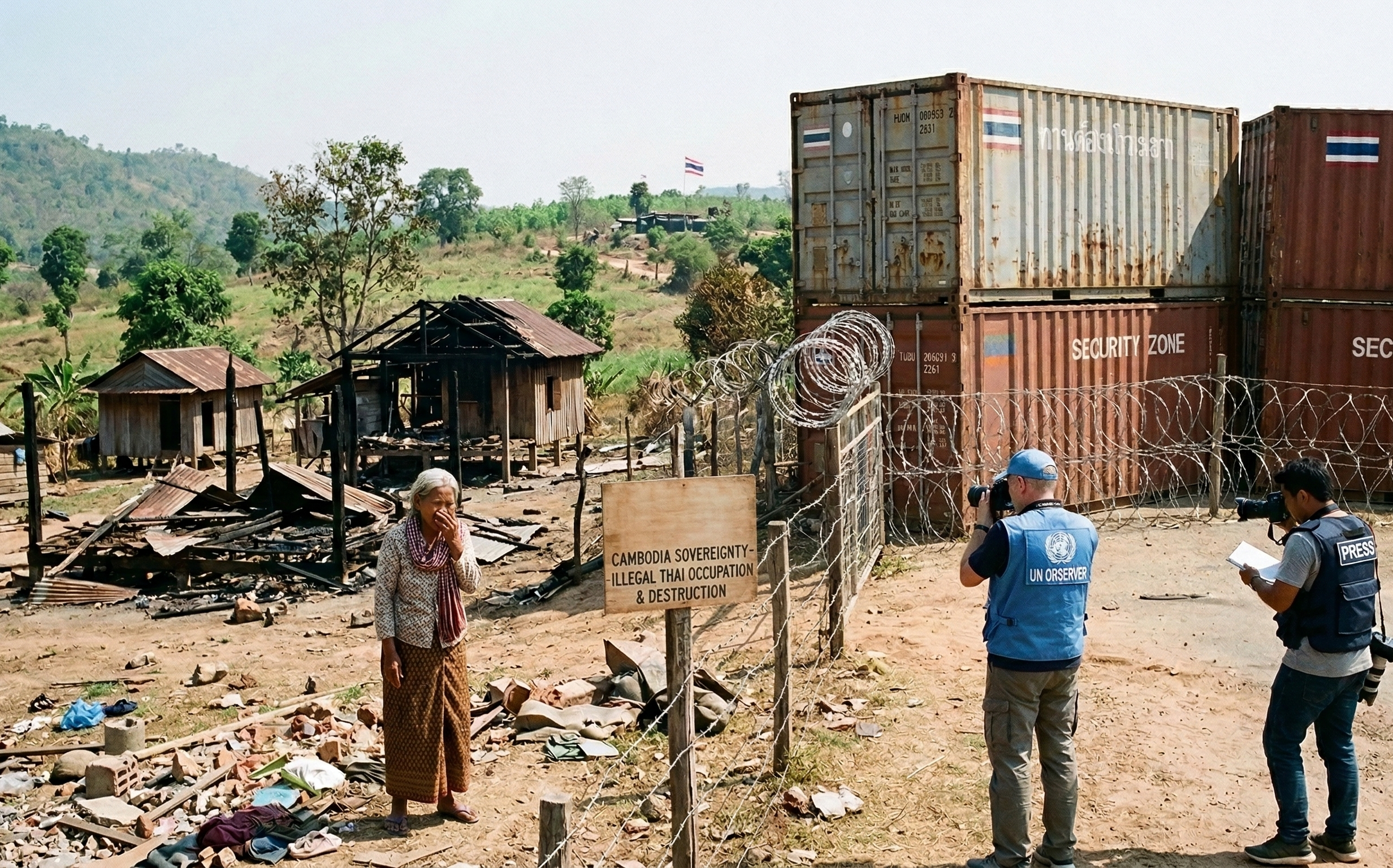
The border dispute between Cambodia and Thailand has reached a critical juncture in early 2026, as allegations of territorial encroachment and human rights violations have surfaced following the late-2025 military standoffs. Central to the escalating tension is the deployment of shipping containers, the installation of barbed wire fences, and the reported destruction of civilian property in disputed “white zones”—actions that Cambodia contends are a direct violation of international law.
This article examines the legal framework surrounding these activities, exploring how such maneuvers may breach the UN Charter’s principles of territorial integrity, the 1907 Franco-Siamese Treaty maps, and the specific mandates of the MOU 2000 and the 2013 International Court of Justice (ICJ) ruling. By analyzing the destruction of civilian infrastructure through the lens of the Geneva Conventions, we investigate whether these actions constitute an illegal occupation and a systematic disregard for established international norms.
1. Territorial Integrity and the Use of Force
Under the UN Charter (Article 2(4)), all member states must refrain from the threat or use of force against the territorial integrity of another state.
- The Claim: Cambodia argues that Thailand’s use of military force in late 2025 to “seize” strategic hills and the subsequent placement of shipping containers and barbed wire inside what Cambodia defines as its territory constitutes an illegal annexation and a violation of sovereignty.
- The Evidence: Cambodia points to the 1904-1907 Franco-Siamese Treaty maps. They argue that any military presence beyond those lines is an “illegal occupation.”
- Thai Counter-Argument: Thailand maintains that these measures are within their own territory and are “security responses” designed to dismantle cross-border scam hubs and prevent illegal infiltration, rather than territorial expansion.
2. Destruction of Civilian Property and Human Rights
If the areas where houses were destroyed are indeed Cambodian territory, several international conventions come into play:
- Hague and Geneva Conventions: These laws prohibit the destruction of civilian property and the “looting” of valuables unless “imperatively demanded by the necessities of war.” Cambodia has filed reports alleging that Thai forces destroyed homes and looted property (including vehicles) in villages like Sangkum Thmei.
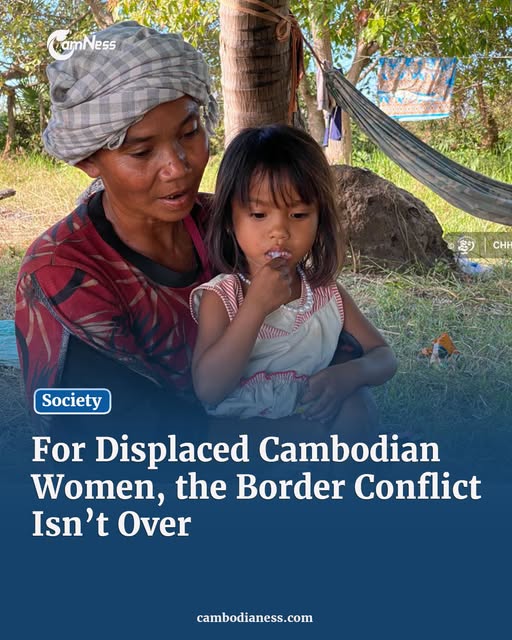
- Humanitarian Impact: The displacement of civilians (estimated between 80,000 and 140,000) and preventing their return to their homes could be viewed as a violation of the International Covenant on Civil and Political Rights (ICCPR), which protects the right to liberty of movement and freedom to choose one’s residence.
3. Violation of the “Status Quo” Agreements
Both nations are signatories to the MOU 2000 and the recent December 27, 2025 Ceasefire Joint Statement.
- Article 5 of MOU 2000: Explicitly states that neither side shall carry out any work that results in the “change of environment” of the frontier zone until the border is fully demarcated.
- Violation: The installation of permanent structures like containers, new road construction, and the planting of national flags in “white zones” (disputed areas) are seen by international legal experts as a breach of this “status quo” agreement.
4. Legal Precedent: The ICJ Rulings
The most powerful “proof” cited by Cambodia is the 2013 ICJ Judgment regarding the Temple of Preah Vihear.
- The Ruling: The Court ruled that Cambodia has sovereignty over the entire promontory of Preah Vihear and that Thailand was under an obligation to withdraw its military and police forces from that vicinity.
- Modern Application: Cambodia argues that Thailand’s current actions in other border sectors (like Oddar Meanchey and Pursat) repeat the same legal errors the ICJ already corrected in 2013—ignoring established colonial-era maps in favor of unilateral military positioning.
Summary of Legal Standpoints
| Action | Potential Violation of… | Cambodian Perspective | Thai Perspective |
| Containers/Barbed Wire | MOU 2000 / UN Charter | Illegal occupation and annexation of land. | Temporary security measures against crime. |
| Destroying Houses | Geneva Conventions | War crime/Human rights violation against civilians. | Clearing “illegal encampments” used by criminals. |
| Troop Deployment | 2025 Ceasefire Agreement | Breach of the “maintain positions” clause. | Compliance with the clause to “protect sovereignty.” |
Current Outlook
As of March 2026, the tension is high following Thailand’s announcement that it may scrap MOU 44 (the maritime boundary deal). Cambodia has already escalated these claims to the UN Human Rights Council and the ASEAN Observer Team (AOT) to seek an international ruling.
Leave a Reply