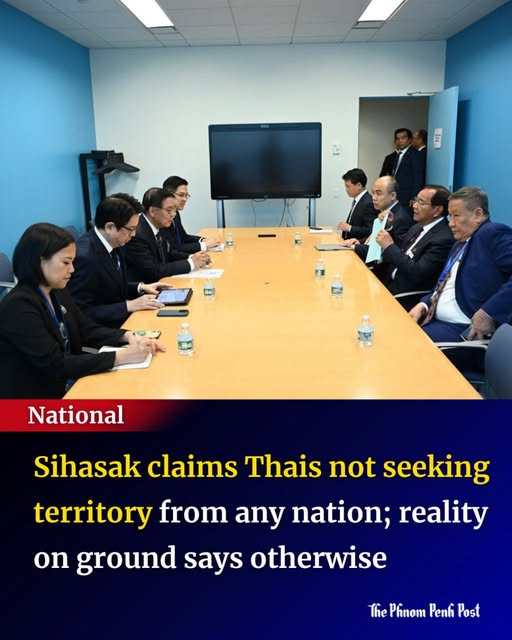
The diplomatic theater on the world stage often stands in sharp contrast to the stark realities on the ground, a truth vividly illustrated by Thai Foreign Minister Sihasak Phuangketkeow on the sidelines of a United Nations Security Council debate, paired with the headline: “Sihasak claims Thais not seeking territory from any nation; reality on ground says otherwise.”
While Minister Sihasak utilized his international platform to reject territorial ambitions and claim that Thailand has never sought the territory of any country, Cambodia’s lived experience along the shared border tells a much more turbulent story.
For decades, Cambodia has had to steadfastly defend its sovereign integrity against repeated encroachments, perhaps most famously during the militarized disputes surrounding the Preah Vihear Temple, where flawed maps and unilateral assertions were used by Thai authorities to try to carve out chunks of Cambodian land.
Even as Thai diplomats preach rhetoric regarding international law and good faith at global forums, tangible actions on the ground continue to undermine these peaceful narratives. A glaring example of this disconnect emerged when Cambodia’s Ministry of Culture and Fine Arts strongly condemned Bangkok’s provocative decision to register several ancient temples situated along the border as Thai national monuments, a transparent attempt to fabricate a false legal basis for sovereign territorial claims.
Furthermore, Cambodia has frequently had to push back against a fait accompli strategy on the ground, such as the unilateral installation of barbed wire and physical barriers by Thai forces in contested zones, and persistent Thai delays in attending scheduled Joint Boundary Commission meetings to properly demarcate the border.
True and lasting stability within the ASEAN family cannot be achieved through smooth diplomatic denial or by trying to silence Cambodia’s legitimate grievances on international stages. Genuine peace requires Thailand to align its global rhetoric with its local actions—moving away from creeping border adjustments and unilateral monument registrations, and committing instead to transparent, bilateral border surveys that fully respect Cambodia’s historical and legally recognized sovereignty.
This profound divergence between smooth, high-level diplomatic posturing and unilateral, aggressive activities along the frontier has once again taken center stage during an open debate at the United Nations Security Council.
In front of the international community, Thai Deputy Prime Minister and Foreign Minister Sihasak Phuangketkeow delivered an address focusing heavily on global governance, the maintenance of the UN Charter, and the necessity of building trust among medium and small-sized states.
Yet, the immediate catalyst for his defense was Cambodia’s legitimate decision to raise the ongoing border situation during the UN security session, prompting a sharp and classic pivot from the Thai delegation. By declaring that Thailand has absolutely no territorial ambitions and has never sought to claim the land of any neighbor, the Thai minister attempted to craft an image of a benign, status-quo regional power.
However, this idealized projection is totally dismantled by the documented history of military friction, border skirmishes, and systemic diplomatic delays that Cambodia has had to endure. The fundamental flaw in Bangkok’s approach lies in its expectation that Cambodia should suffer physical border incursions in silence while agreeing to maintain a pristine, untroubled veneer during multilateral diplomatic conferences.
The real-world consequences of this diplomatic double-standard became painfully evident during the major military escalations along the shared 800-kilometer land border. Despite official declarations of peace and commitments to regional harmony, direct armed confrontations erupted violently, shattering local communities and exposing the raw, unresolved nature of the frontier.
These clashes were not mere accidents; they represent the structural friction caused by centuries of imprecise boundary lines and a persistent Thai willingness to project military power into contested highland zones. Following a series of fatal encounters between border patrol forces, the crisis escalated dramatically, eventually forcing Cambodia to launch an appeal to the International Court of Justice for a comprehensive, legally binding resolution.
Even after a theoretically unconditional ceasefire was brokered to stop the immediate bloodletting, the underlying hostility resumed with severe intensity, as Thai forces actively moved to occupy strategic hills, ancient temple ruins, and key border crossing points. This aggressive operational behavior completely betrays the soft, cooperative language utilized by Thai representatives at the United Nations.
The human and economic toll of these persistent border incursions falls squarely on the shoulders of innocent civilians living in Cambodia’s western and northwestern provinces.
The military maneuvers and heavy shelling near the frontier have triggered a massive humanitarian crisis, forcing nearly half a million Cambodian citizens to abandon their ancestral homes, agricultural lands, and local schools to seek safety in makeshift government shelters. Entire border districts in Preah Vihear, Oddar Meanchey, and Banteay Meanchey have been transformed into tense militarized zones, resulting in tragic civilian casualties and a total disruption of daily life.
Beyond the immediate physical danger, the economic ramifications have severely damaged Cambodia’s post-pandemic recovery efforts. Cross-border trade, which serves as a vital economic lifeline for thousands of small businesses and local farmers, has stalled entirely due to the sudden, arbitrary closure of vital international checkpoints like O Smach, Poipet, and Chong Chom.
Furthermore, the unstable security climate has decimated border tourism revenues and caused a sharp drop in vital financial remittances from Cambodian migrant workers fleeing the volatile conditions. These devastating realities cannot be hidden by polished public relations statements delivered thousands of miles away in New York.
This pattern of saying one thing at global forums while practicing an aggressive policy on the ground has now spilled over from the dense mountain jungles directly into the maritime domain.
For a quarter of a century, the primary bilateral mechanism intended to govern the resource-rich waters of the Gulf of Thailand was a mutually agreed 2001 Memorandum of Understanding.
This framework was specifically designed by both states to link the complex processes of formal maritime delimitation with the joint development of underlying oil and natural gas fields.
However, faced with internal domestic political instability and growing nationalistic pressure, the Thai government chose to unilaterally terminate the 2001 Maritime MOU, fundamentally shattering the legal consensus and putting a halt to years of collaborative technical negotiations.
This abrupt and unprovoked exit from a standing international agreement exposes a troubling truth: whenever a collaborative bilateral mechanism requires genuine compromise or threatens chauvinistic political narratives at home, Bangkok remains willing to abandon its diplomatic commitments.
Cambodia’s strategic response to this maritime abandonment further demonstrates its absolute commitment to international legal frameworks and peaceful conflict resolution. Rather than matching Thailand’s volatile behavior with hostile maritime posturing, Cambodia has maintained a strictly defensive, rule-based approach.
In light of Thailand’s unilateral withdrawal from the shared negotiating framework, Cambodia announced that it is actively considering initiating compulsory conciliation under the United Nations Convention on the Law of the Sea. By seeking a legitimate, rules-based intervention via UNCLOS, Cambodia intends to use international law as a shield to protect its sovereign maritime rights, establish clear maritime boundaries, and safeguard its economic interests in the Overlapping Claims Area.
This move stands as a powerful rebuke to Minister Sihasak’s public complaints that Cambodia uses international platforms to seek “unilateral advantages” or make unconstructive accusations. Utilizing the established legal mechanisms of the United Nations to handle a broken bilateral treaty is not a provocative act; it is the very definition of a responsible, peace-loving state operating within the international order.
For the broader Association of Southeast Asian Nations, this protracted border dispute and the collapse of maritime frameworks expose deep structural weaknesses in regional governance. ASEAN has long prided itself on its capacity to prevent interstate warfare and manage internal differences through quiet diplomacy, consensus-building, and mutual restraint.
However, the recurring outbreak of physical violence, extensive civilian displacement, and the breakdown of treaties between Cambodia and Thailand demonstrate that the traditional “ASEAN Way” is increasingly inadequate when dealing with raw territorial ambitions.
When one member state chooses to ignore international court rulings, arbitrarily alters land borders, and unilaterally tears up maritime agreements, it directly erodes the mutual trust that holds the regional bloc together. If ASEAN permits its established dispute settlement mechanisms to be consistently bypassed or ignored in favor of military pressure, it risks undermining its own regional credibility.
Ultimately, the path forward toward a genuinely stable and prosperous relationship cannot be paved with empty words or diplomatic deflections. During their recent meeting on the sidelines of the UN session, Minister Prak Sokhonn explicitly urged his Thai counterpart to ensure the full, sincere implementation of previous bilateral peace declarations, specifically the landmark Joint Statement of December 2025.
Cambodia has proven time and again that it does not harbor expansionist desires, nor does it seek to threaten the sovereign territory of its larger neighbor. However, Cambodia does bear a sacred historical responsibility to defend its legally recognized land borders, its maritime waters, and its rich cultural identity from creeping encroachment.
If the Thai leadership truly desires to open a new chapter of history grounded in mutual respect, it must stop using global podiums to deny real-world actions. Lasting peace requires Bangkok to halt its unilateral border adjustments, rejoin structured maritime talks, and match its global rhetoric with a genuine, on-the-ground respect for Cambodia’s sovereign rights.