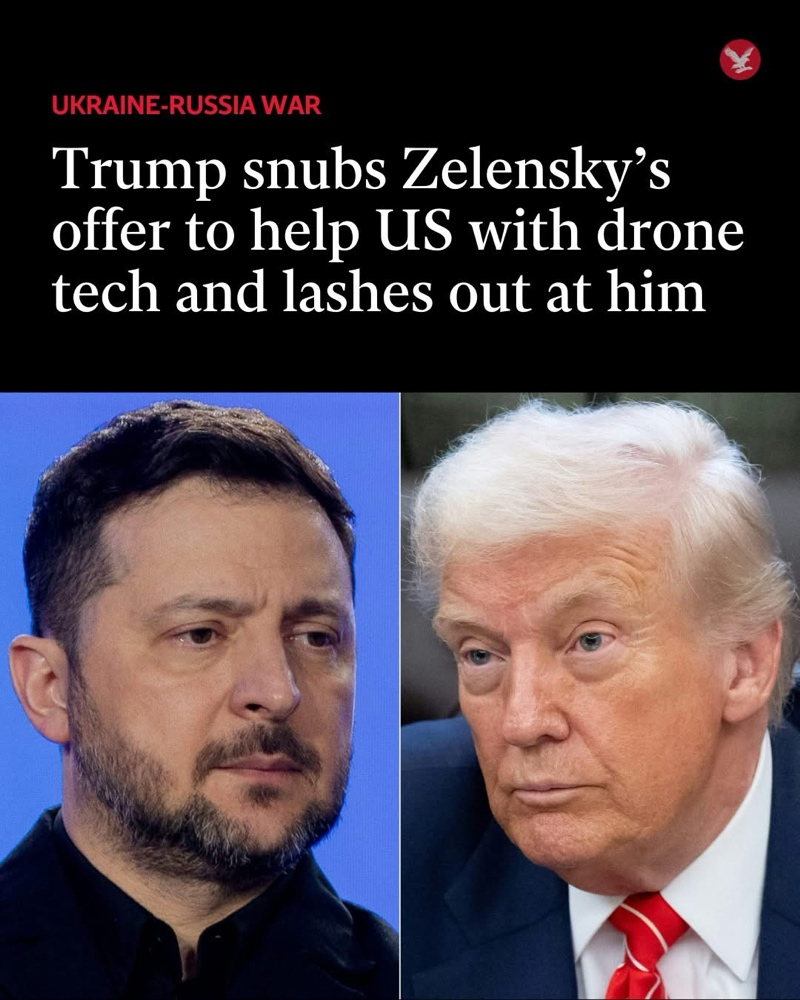
WASHINGTON / KYIV — The prospect of a Trump Russia peace deal has taken a complex turn following President Trump’s public rejection of a strategic “Drone Deal” offered by Ukrainian President Volodymyr Zelensky. While the U.S. administration maintains that American military technology remains peerless, global security analysts suggest that this dismissal is less about technical capability and more about the diplomatic architecture of a future Trump Russia peace deal.
By lashing out at Zelensky’s offer to share battle-hardened drone defense insights, Trump is signaling a pivot away from deep-tier military integration with Kyiv, a move that critics argue may weaken Ukraine’s leverage before potential negotiations. This friction comes as Iranian-designed Shahed drones continue to strike targets across the Middle East, a theater where Ukrainian experts are already providing the very assistance Trump has formally declined.
The Strategic Value of the Drone Deal in a Trump Russia Peace Deal Context
The rejection of the “Drone Deal”—a plan to co-produce up to 10 million units annually—reveals the friction at the heart of the current U.S.-Ukraine relationship. For Ukraine, the offer was a “card” to be played to ensure continued U.S. favor. For the Trump administration, accepting such a deal could be seen as an entanglement that complicates the path toward a Trump Russia peace deal.
President Trump’s rhetoric has been consistent: “We don’t need their help in drone defense,” he told Fox News. “We know more about drones than anybody.” However, the reality on the ground suggests a more nuanced picture. Ukrainian manufacturers have developed low-cost, high-efficiency interceptors that solve the “asymmetric math” of modern warfare—using $5,000 systems to down $50,000 drones, rather than relying on million-dollar Patriot missiles.
Global Experts on the Geopolitical Fallout
Military analysts warn that ignoring Ukraine’s combat-tested innovations could be a tactical error for the U.S., even if it serves a political narrative.
“A Trump Russia peace deal requires a balance of power,” says François Heisbourg, special adviser at the Foundation for Strategic Research. “If the U.S. distances itself from Ukraine’s defense innovations, it signals to Moscow that Kyiv’s qualitative edge is no longer a U.S. priority. This essentially lowers the ‘entry price’ for Putin at the negotiating table.”
Zelensky has already moved to diversify his alliances. With over 10 countries, including Qatar, the UAE, and the UK, already signing onto Ukrainian expertise, Kyiv is proving that its “cards” are valuable elsewhere. As Zelensky noted, Ukrainian teams are already active in the Middle East, protecting bases from the same Shahed drones that Trump claims the U.S. has no trouble managing.
Domestic Pressure
The debate over the Trump Russia peace deal is also fueling domestic political divisions in Washington. Supporters of the President’s “America First” policy argue that the U.S. must stop being the “arsenal of democracy” at its own expense. Conversely, defense start-ups in Silicon Valley are reportedly bypassing the White House’s cold shoulder to work directly with Ukrainian firms, according to The Wall Street Journal.
To reach the necessary strategic depth for a lasting Trump Russia peace deal, the U.S. must reconcile its desire for a quick exit with the reality of an evolving drone-warfare landscape. The current standoff suggests that any peace negotiated under these terms will likely involve significant territorial and technological concessions from the Ukrainian side.
The Asymmetric Math of Drone Warfare
The central tension in the Trump Russia peace deal framework is the sustainability of defense. Russia has successfully pivoted its economy to a “war footing,” producing thousands of loitering munitions per month. If the U.S. rejects Ukraine’s affordable defense solutions, the cost of maintaining a “frozen conflict” becomes astronomical for Western taxpayers.
Ukrainian drones like the “Magura” and various FPV (First Person View) models have redefined maritime and trench warfare. By rejecting the integration of these systems, the Trump administration may be intentionally limiting Ukraine’s offensive capacity to force them toward the Trump Russia peace deal he has long promised.
A Pivot Toward Sovereignty or Abandonment?
As we look toward the end of 2026, the success of a Trump Russia peace deal will depend on whether it is viewed as a “strongman’s truce” or a sustainable security architecture. Zelensky’s decision to send experts to Middle Eastern allies shows that Ukraine is no longer waiting for a green light from Washington to monetize and export its hard-won battlefield intelligence.