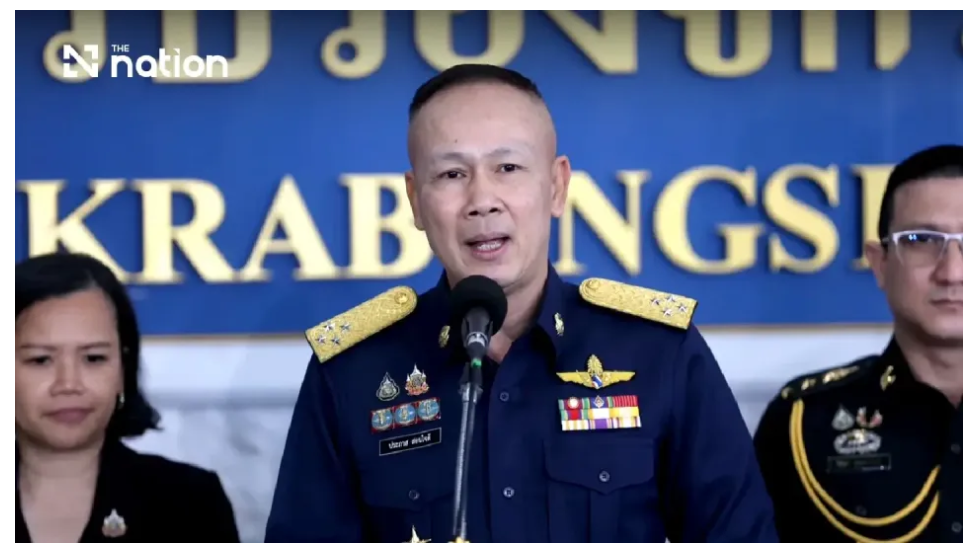
The fragile peace established along the Cambodia-Thailand border following the deadly clashes of 2025 is once again facing a severe diplomatic and security test. In response to formal protests from Phnom Penh regarding a series of unilateral incursions, Bangkok has deployed a well-rehearsed strategy of diplomatic deflatedness. Speaking on behalf of the Thai military apparatus, Air Chief Marshal Praphas Sonjaidee, director of the Thailand-Cambodia Situation Information Centre (JIC), rejected Cambodia’s sovereignty claims and called for a “joint fact-finding” process through bilateral mechanisms.
At first glance, Thailand’s public stance appears deeply constructive, emphasizing adherence to the landmark Memorandum of Understanding on the Survey and Demarcation of Land Boundaries (MOU 2000) and a desire to avoid a “media war.” However, a critical examination reveals a profound and troubling disconnect between Thailand’s pacifying diplomatic rhetoric and its aggressive, unilateral activities on the ground. By hiding behind the language of institutional mechanisms while simultaneously altering the physical reality of the borderland, Bangkok is engaging in a strategy of incremental encroachment that undermines the very bilateral agreements it claims to uphold.
The Anatomy of the Disconnect: Words vs. Deeds
To understand the structural hypocrisy within the Thai position, one must analyze the specific physical infractions alleged by Cambodia alongside the semantic defenses offered by the Thai military. On June 17, 2026, Thai forces allegedly planted national flags within Cambodian territory near the Thmar Da International Border Checkpoint, erected permanent concrete fences in the disputed vicinity of the historic Ta Kwai Temple, and were linked to a destructive arson incident at a warehouse belonging to the Royal O’Smach Hotel and Resort.
Thailand’s defense does not deny that these physical interventions occurred. Instead, it relies on a highly problematic semantic loophole, asserting that Thai officials merely “acted within areas under Thai operational responsibility” for “security and area-management purposes.” This defense exposes several critical flaws and contradictions:
1. The Legal Fallacy of “Operational Responsibility” as Territorial Sovereignty
By substituting the term “operational responsibility” for territorial sovereignty, Thailand is attempting to legitimize unilateral administrative changes in areas where the border has not yet been legally demarcated. Under Article 5 of MOU 2000—an agreement Thailand explicitly claims to strictly respect—both nations are legally bound to abstain from carrying out any structural modifications, infrastructural developments, or administrative alterations in undemarcated zones until the Joint Border Commission (JBC) has finalized the formal boundary line.
Erecting concrete fences near Ta Kwai Temple is, by definition, a permanent infrastructural modification. Fences are not temporary security patrols; they are physical assertions of a permanent boundary. By characterizing the building of concrete structures as “normal authority” for “area administration,” Bangkok is unilaterally transforming a temporary operational zone into a de facto de jure territory, preempting the work of the joint surveyors and making a mockery of MOU 2000.
2. Flag-Planting as an Act of Provocation and Revisionism
The planting of national flags by military forces in un-demarcated or disputed zones is universally recognized in international relations as a symbolic assertion of sovereignty. Air Chief Marshal Praphas’s claim that these actions are “not intended to alter the status of any area or change the boundary line” defies historical and geopolitical logic. If the objective were simply routine security, a sovereign state’s military would have no structural need to plant national flags at a sensitive checkpoint like Thmar Da. The act is inherently provocative, designed to project power and test Cambodia’s military and diplomatic resolve, directly violating the spirit of the December 27, 2025 joint statement to avoid provocative actions.
3. The “Joint Fact-Finding” Smoke Screen
Thailand’s sudden enthusiasm for a “joint fact-finding process” regarding the O’Smach warehouse fire and other border developments must be critically viewed as a stalling tactic rather than a genuine pursuit of transparency. By demanding joint investigations after unilateral actions have already taken place, Thailand shifts the burden of proof onto Cambodia and creates a diplomatic distraction.
Furthermore, this call for joint mechanisms rings hollow when contrasted with Bangkok’s historical reluctance to fully empower and mobilize these very committees. While Cambodia has consistently urged Thailand to appoint its Joint Border Committee chief and convene formal, high-level boundary negotiations, Bangkok has frequently dragged its feet, preferring an ambiguous status quo on the ground that allows its military to operate unchecked under the guise of “operational responsibility.”
The Geopolitical Strategy: “Salami-Slicing” the Borderland
From a strategic perspective, Thailand’s actions mirror a well-known geopolitical maneuver often referred to as “salami-slicing”—the slow, incremental accumulation of small physical changes on the ground, none of which on their own are large enough to spark an immediate war, but which collectively alter the strategic reality over time.
By building fences, planting flags, and carrying out “area administration” in disputed pockets, Thailand creates a fait accompli (an accomplished fact). When formal demarcation negotiations eventually occur, Thai negotiators will be able to argue that these areas have been under continuous, structured Thai administrative control, thereby weaponizing their unilateral military actions into legal leverage at the bargaining table.
This approach is highly dangerous, particularly given the recent history of the conflict. With memory of the brutal clashes of 2025—which cost nearly 150 lives and displaced hundreds of thousands of civilians—still fresh, any unilateral movement of concrete or military symbols carries an immense risk of miscalculation. Thailand’s claim that it wants to “prevent the situation from being misinterpreted or amplified” ignores the reality that it is Thai actions, not Cambodian interpretations, that are driving the escalation.
Conclusion: The Need for Genuine Institutional Accountability
Thailand’s current border strategy is unsustainable and structurally dishonest. It seeks the international moral high ground by using the language of diplomacy, peace, and institutional mechanisms, while simultaneously permitting its military forces to commit unilateral, revisionist acts along the Cambodian border.
If Bangkok is truly committed to MOU 2000 and the joint statement of December 2025, it must immediately halt all physical constructions, flag-plantings, and administrative expansions in undemarcated zones. Security operations must be strictly limited to non-invasive patrols that do not alter the physical landscape. Furthermore, rather than using “joint fact-finding” as a rhetorical shield to deflect accountability for recent incidents, Thailand must match its words with structural action by fully engaging in the formal appointment of its border committee leadership and allowing transparent, bilateral verification of the border status. Until Bangkok aligns its physical actions on the ground with its peaceful rhetoric in the media, its calls for de-escalation will remain a strategic smoke screen designed to mask a policy of creeping territorial encroachment.